






Accurate density measurement plays a vital role in quality control, research, and product development across a variety of industries. From testing chemicals, pharmaceuticals, petroleum products, to beverages and other speciality materials, choosing the right density meter can improve efficiency, ensure compliance, and deliver reliable results.
With multiple models available, choosing the best density meter depends on the accuracy requirements of your laboratory, the type of samples and the applications.
What is a density meter?
A density meter is an analytical instrument used to measure the density or specific gravity of liquids, and in some specialised applications of solids or gases. Instruments like density meters for solids and digital density meters for liquids are heavily used for quality control, concentration analysis, and material identification in industries like chemical, pharmaceuticals, petroleum, cosmetics, perfumes and food and beverage.
Why Density Measurement Matters For Your Laboratory?
Density is a crucial physical property that affects product quality and is related to concentration, purity, consistency and industry standard compliance. The advanced digital density meters deliver fast, accurate and repeatable results and minimize the involvement of the operator and associated errors.
Working principle of the density meter
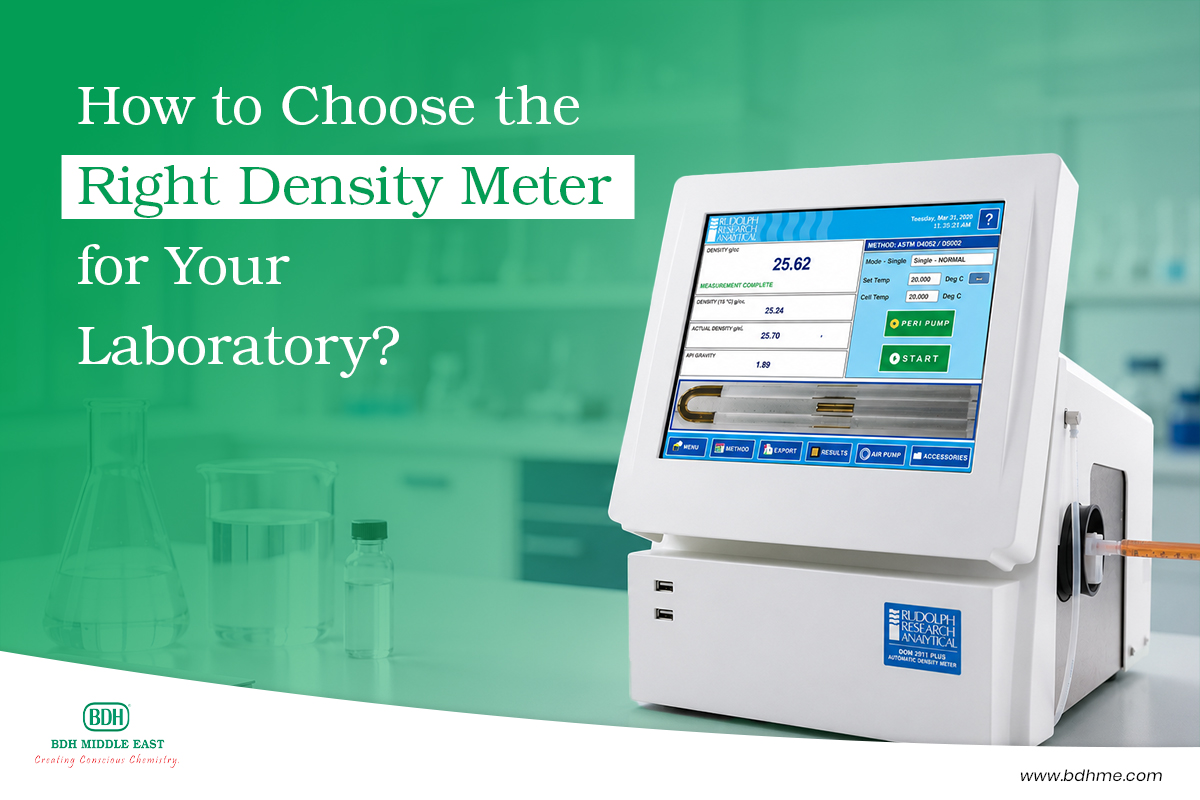
The operation of a Rudolph DDM Series density meter relies on the Mechanical oscillation principle and the gravimetric method.
These density meters use the technique of oscillating U-tubes, whereby a sample is put inside an oscillating U-shaped tube. By measuring the change in frequency due to the presence of the sample, the meter automatically computes the density, specific gravity, or API gravity of the sample, which is highly accurate. This technique is commonly applied in laboratory analysis in industries such as petrochemicals and beverages.
How to Measure the Density of Solids?
To find a density meter for solids, you need to know the mass of the solid, which you can find out by using a calibrated weighing scale. Then, take its volume. The volume of regularly shaped solids can be calculated from their dimensions using geometric formulas. Water displacement is also the standard method for irregular-shaped solids — they are submerged in water and the rise in water level is measured. When both are known, density can be found by dividing the mass by the volume. a process simplified by modern laboratory testing equipment.The density that is calculated is usually converted into g/cm³ or kg/m³ which can be used for material identification and for the investigation of its properties.
How to Measure the Density of Liquids?
To measure the density of a liquid using a digital density meter for liquids, you must first load the sample into a syringe. If the sample is too viscous to manually inject, you may need the assistance of an automated system and a heated interface. Once the sample is loaded, you must then check for air bubbles. Air Bubbles yield a lower oscillation of the U-Tube, and your measurement won’t be accurate. After you have checked and there are no air bubbles, press the Start button, and you will have a measurement reading typically 30-40 seconds after thermal equilibration. After the measurement is complete, your results will be automatically saved and/or exported to a thumb drive, Network, LIMS, SAP, etc.
Types of Density Meters
- Portable Density Meters: this is a small, lightweight, and rugged density meters that provide fast and accurate density measurements in the field. These instruments have user-friendly interfaces and can be used in any application in which density needs to be measured on-site. Their portability makes them applicable to a variety of industries, including food and beverage, petroleum, and pharmaceuticals, offering fast and trustworthy information without having to establish a full lab.
- Bench-top Density Meters: Designed for accurate density determination in the laboratory. These instruments provide improved precision and repeatability over portable density meters and are suited for applications where measurements are critical. Benchtop density meters can also come with sophisticated software, adjustable settings, and can test multiple kinds of samples, which makes them useful in research and quality assurance in fields like Petroleum, Pharma, Flavour and Fragrance, chemistry, and material science.
- Temperature-controlled Density Meters: These are specialized instruments that integrate accurate temperature regulation mechanisms into the density measurement process. These devices ensure accuracy by controlling temperature variations. Commonly used in industries like the Chemical and Petrochemical sectors, these types of density meters allow operators to obtain highly accurate density readings by maintaining a constant temperature, critical for reproducible and repeatable results for your applications.
How to Choose the right density meter for your Laboratories
1. Accuracy & Precision
The required level of accuracy needed depends upon your application. In the case of normal quality control testing, a conventional accuracy density meter would suffice. But these are also areas which typically demand a higher degree of accuracy to guarantee quality of product, compliance with regulations and repeat results. Rudolph Research offers a variety of density meter models to accommodate a range of accuracy needs:
Rudolph Research offers multiple density meter models designed for different accuracy requirements:
Models:
Density Meter DDM 2909 – Entry-level automatic density meter for routine laboratory density and specific gravity testing.
Density Meter DDM 2910 – High-performance digital density meter for chemical, petroleum, pharmaceutical, and beverage applications.
Density Meter DDM 2911 – Advanced laboratory density meter delivering exceptional accuracy for demanding analytical measurements.
Density Meter DDM 2911 PLUS – Premium density meter offering the highest accuracy, the widest range, and advanced compliance features.
Portable Density Meter DDM 29 – Lightweight portable density meter for fast, accurate field and laboratory testing.
The DDM 2911 is ideal for laboratories that require the highest measurement precision and repeatability across the, such as chemical, beverage, pharmaceutical, fragrance, and petroleum industries.
2. Sample Types and Measurement Range
A good density meter should accommodate a wide variety of samples, from low-viscosity liquids to more challenging chemical formulations.
Rudolph Research DDM Series density meters offer:
- Density range: 0 to 3 g/cm³
- Temperature-controlled measurements
- Full-range viscosity correction
- Automatic bubble detection
- Oscillating U-Tube with Viscosity Correction
These features help ensure accurate results even when testing difficult samples.
3. Method Compliance
An important consideration in selecting a density meter is conformance to popular international test standards. The Rudolph DDM Series Density Meters accommodate a diverse range of international protocols, allowing for precision and reliability in measurement throughout the petroleum, chemical, pharmaceutical, cosmetics, perfumes, flavours and beverages & food sectors.
The Rudolph DDM Series Density meters meet the requirements of most major ASTM, ISO, ABNT, GB/T, IP, and DIN standards, such as ASTM D1250, ASTM D1475, ASTM 2501, ASTM D4052, ASTM D5002, ISO 12185, ISO 15212, IP 365, and DIN 51757.
4. Ease of Operations
Laboratory productivity depends on how quickly operators can perform measurements.
Look for features such as:
- Large touchscreen display
- Automated measurement procedures
- Easy method creation
- Data storage and retrieval
- Network connectivity
The Rudolph DDM Series includes a user-friendly touchscreen interface, Windows-based operation, and extensive data management capabilities, making daily testing simple and efficient.
5. Compliance and Data Integrity
For regulated industries like pharmaceuticals and chemicals, compliance is non-negotiable.
Features to consider include:
- Electronic signatures
- Secure data storage
- Audit trails
- IQ/OQ/PQ documentation
- GMP and GLP support
The DDM 2910 and DDM 2911 support 21 CFR Part 11 compliance and are designed for cGMP and GLP laboratory environments.
6. Bubble Detection Technology
One of the most common causes of density measurement errors is trapped air bubbles.
Advanced density meters should include automatic bubble detection systems that help operators identify and eliminate measurement issues before results are recorded.
Rudolph’s patented VideoView™ Bubble Detection technology provides magnified visual inspection of the measurement cell and automatically alerts users to bubbles in the sample.
7. Maintenance and Service Support
Reliable service and easy maintenance are essential for long-term performance. Choose a density meter with simple calibration, easy cleaning, readily available spare parts, and strong technical support to ensure maximum uptime and measurement accuracy.
Industries That Use Density Meters
Petroleum & Petrochemical
Petroleum density meters and petrochemical density meters play a critical role in ensuring product quality, process efficiency, regulatory compliance, and accurate characterization of petroleum products. Often serving as core petroleum testing instruments.
- Crude oil testing
- Fuel quality control
- API gravity measurements
- Lubricant analysis
Chemical Manufacturing
Accurate density analysis helps manufacturers maintain consistent product quality, verify raw materials, optimise processes, and reduce production errors.
- Raw material verification
- Concentration measurements
- Batch consistency checks
- Process control
Pharmaceutical
Precise density measurements support pharmaceutical quality assurance, formulation accuracy, regulatory compliance, and consistent production throughout manufacturing processes.
- Formulation development
- Raw material testing
- Product release testing
- Regulatory compliance
Food & Beverage
Density testing ensures product consistency, ingredient accuracy, quality control, and compliance with industry standards across beverage production.
- Sugar concentration (°Brix)
- Alcohol measurements
- Beverage quality control
- Filling process monitoring
Perfumes & Fragrance
Reliable density measurement helps maintain fragrance quality, verify ingredients, ensure consistency, and support efficient production processes.
- Raw Material Verification
- Alcohol Concentration
- Quality Control (QC)
- Batch Consistency
Research & Academic Laboratories
Advanced density measurement enables researchers to perform accurate material characterization, analytical studies, and innovative product development projects.
- Material characterization
- Product development
- Analytical testing
Rudolph density meters are widely used across these industries because they combine accuracy, automation, and compliance-ready features.
Which Density Meter Is Right for You?
Choose the DDM 2909 if you need a reliable density meter for routine chemical and petroleum testing. It provides reliable performance, ease of operation, and results you can trust in routine quality assurance or laboratory testing.
Choose the DDM 2910 if you need advanced compliance, superior data handling and broad application support. It is the perfect solution for laboratories that want to enhance their traceability, efficiency of operations and regulatory adherence in a variety of industries.
Choose the DDM 2911 when your requirements are for the highest accuracy in pharmaceutical, chemical, petroleum, fragrance, or research applications. Its high accuracy and repeatability make it ideal for critical measurements and advanced analytical applications
The importance of calibration service in the Density measurements
The calibration is essential for accurate, reliable and traceable density measurement. For example, as time goes by, equipment performance can be affected by factors such as temperature variations and mechanical wear. checks Calibration services whether the device is performing to specifications in terms of accuracy. Density meter calibration is especially important in fields such as oil, pharmaceutical, chemical, and food processing industries, where any minor error in measurements may affect end-product quality.
Common mistakes
- The presence of air bubbles in the test specimen results in errors.
- Failure to clean the tube properly before measuring different samples.
- Use of contaminated samples.
- Absence of calibration of the instrument regularly.
- Lack of controlled temperature conditions while taking measurements.
- Failure to fill the sample properly into the tube, particularly for viscous samples.
- Violation of the manufacturer’s instructions for operating the equipment.
Maintenance tips for your density meter
- The U-tube is cleaned after each measure to prevent residues from building up.
- Use only approved cleaning agents.
- Check for potential air bubbles, leaks, or contamination before starting the measurement.
- Calibration has to be carried out from time to time using certified standard samples.
- The measurements require the temperature to be stable.
- Follow the maintenance schedules recommended by the manufacturer.
Final Thoughts
Choosing the best density meter for your laboratory applications increases your productivity, provides a greater sense of assurance in measurement and maintains regulatory standards. In applications such as the pharmaceutical, cosmetic, petroleum, or chemical industries, a smart and robust instrument designed for optimal efficiency and for use in demanding laboratory environments is key. The Rudolph DDM2910 & DDM2911 Density Meters provide unprecedented automation, intelligent sample handling and an unparalleled commitment to international standards for accurate, repeatable measurements.
As an authorised distributor in the Middle East, BDH Middle East provides comprehensive support for density measurement solutions, from initial equipment selection to full turnkey solutions helping laboratories select the most suitable instrument for their specific testing requirements